PBR — Frequently Asked Questions
Common questions from buyers, procurement teams, and engineers. If you don't see your question here, email marketingoem@pbrubberindo.co.id or use the contact form. Replies in English, Indonesian, or Japanese.
About the Company
How long has PBR been manufacturing rubber parts?
PBR (PT. Putrabangun Rubberindo) has manufactured OEM rubber parts since 2003 — more than 22 years. The company was founded in Slipi, Jakarta on a 200 sqm shop floor and relocated in 2006 to a purpose-built 10,000 sqm facility in Cikupamas, Tangerang where production continues today.
What does PBR (PT. Putrabangun Rubberindo) manufacture?
OEM rubber parts including engine mountings, rubber bushings, hoses, seals (oil, water pump, drum), custom molded rubber components, rubber-to-metal bonded assemblies, and silicon parts for high-voltage power infrastructure. Production is based in Tangerang, Indonesia.
Which automotive OEMs does PBR supply?
Named in our official company profile, our 4-wheel automotive OEM customers include Hino, Suzuki, Honda, ROKI Co. Ltd, APM, GSS, BMT, TACI, and PT. Enomoto Srikandi Industries. We also supply 2-wheel automotive OEM programs.
Has PBR received any quality awards?
Yes. We were named Best Supplier 2009 by PT. Hino Motors Sales Indonesia, recognised on 25 January 2010 and signed by President Director Toshiro Mizutani. We have also received Best Vendor Performance recognition for 2010 and multiple Certificates of Appreciation.
Where is PBR's factory located?
Our 10,000 sqm factory is at Jl. Talaga Mas I no. 1, Cikupa, Tangerang 15710, Indonesia (occupied since 2006). Our head office is at Jl. Jalur Sutera Barat, Ruko The Prominence 38D, Tangerang.
Who is the contact person for OEM sales?
OEM sales inquiries go to marketingoem@pbrubberindo.co.id or +62 21 8060 4251. A dedicated account manager is assigned once your inquiry is qualified. Trilingual EN/ID/JA correspondence available.
Manufacturing Capabilities
How many molding machines does PBR operate?
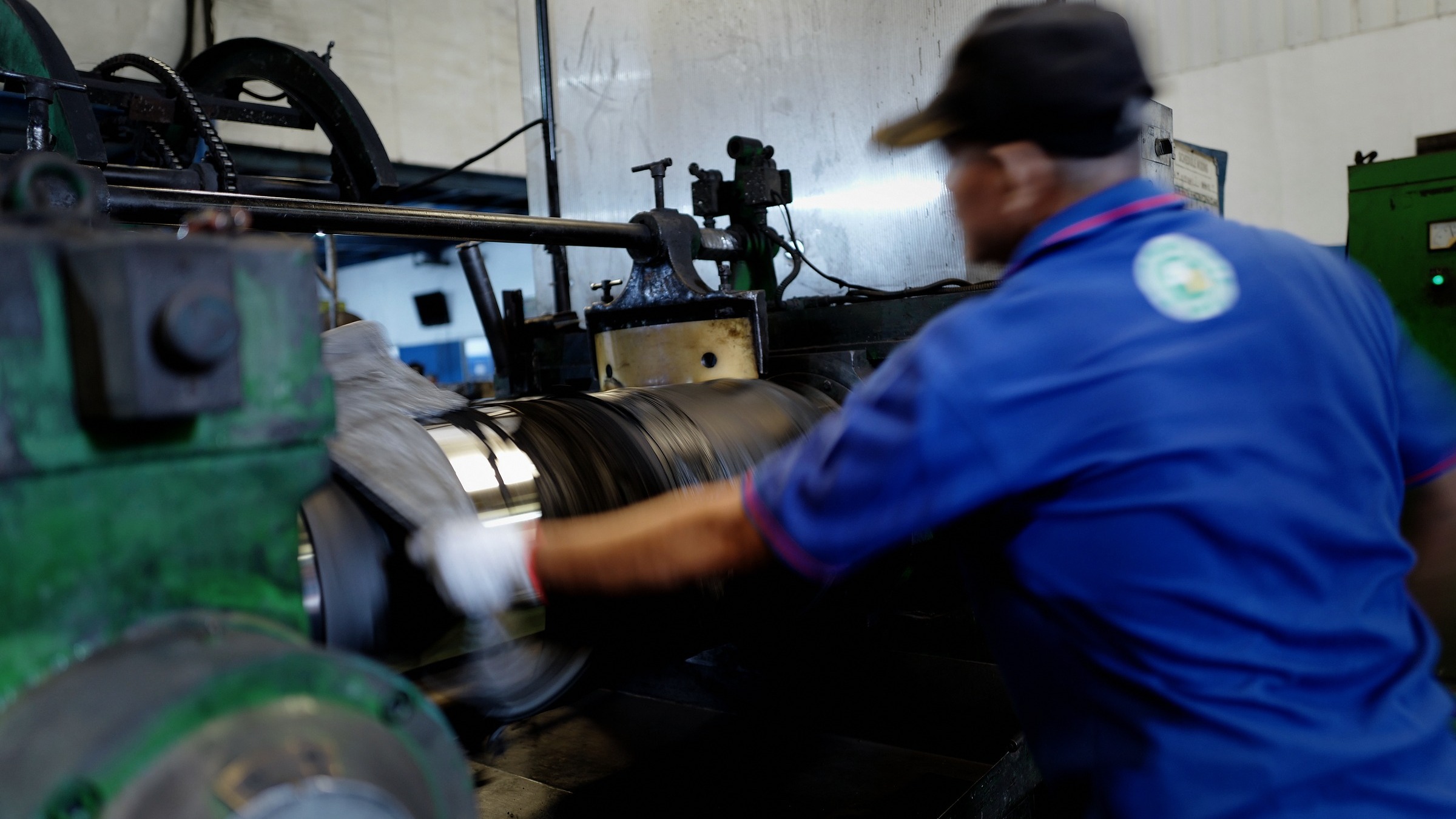
Our Cikupa factory runs roughly 65 molding machines including 9 cold runner injection presses, 46 compression machines, 4 hot runner injection presses, 3 vacuum molding presses, and 3 post-cure ovens. Supporting equipment includes 4 CNC lathes, 70-ton power presses, hydraulic assembly, in-house CNC mold milling, and an FDM 3D printer.
What is cold runner injection in rubber manufacturing?
Cold runner injection is a rubber molding process where the runner channels — the system that delivers uncured rubber from the press nozzle to the mold cavities — are kept at a low temperature. The rubber inside the runners stays uncured between shots and is reused on the next cycle. This reduces material waste, produces cleaner parts with less flash, and gives more consistent cures.
Does PBR make its own molds?
Most of them — yes. We operate in-house CNC mold milling and an FDM 3D printer for prototyping, which covers the majority of our tooling needs. For extremely difficult or highly specialized parts, we partner with a small set of vetted external tool makers we've worked with for years. That hybrid approach gives every program the right route to tooling — shorter lead time and direct iteration for in-house molds, the right specialist hands on the truly complex jobs.
Does PBR do rubber-to-metal bonding?
Yes. Rubber-to-metal bonding is one of our specialty capabilities. We bond rubber compounds to steel, aluminum, and brass inserts for engine mountings, suspension bushings, vibration isolators, and custom assemblies. The process includes surface preparation, bonding agents, simultaneous molding-and-cure, and adhesion pull-testing.
Does PBR make custom rubber parts?
Yes. We produce custom molded rubber parts from your engineering drawing, physical sample, or design concept. The process covers tooling design (primarily CNC-milled in-house; vetted external partners for advanced tooling), prototype molding, validation, and series production. Hardness, compound family, and bonded-metal options are all configurable.
Can PBR reverse-engineer a part from a sample?
Yes. Send us the physical sample, and our engineering team will measure dimensions, identify the compound family, recommend a material specification, and prepare a quote with tooling design.
Materials and Compounds
What rubber materials and compounds do you process?
We process NBR (nitrile), EPDM, SBR, natural rubber (NR), CR (neoprene), FKM (fluoroelastomer), and silicone. Raw polymers are sourced from premium suppliers including Lanxess, ExxonMobil, and Sumitomo. Compounding is done in-house on 2 open roll mills, a 55-litre kneader, and a 75-litre kneader, with an automatic chemical weighing system controlling additive accuracy.
Certifications and Quality
Is PBR ISO certified?
Yes. PBR holds ISO 9001:2015 certification, issued by SGS, covering the manufacture of rubber and rubber-to-metal bonded parts at our Cikupa factory. We were first certified to ISO 9001:2008 in 2009 and have maintained continuous certification since. PPAP-style documentation, APQP, FMEA, and SPC are available on request.
Do you provide material test reports?
Yes. Material certificates, dimensional inspection reports, and (on request) third-party test reports for hardness, tensile, compression set, and aging are available. Per-batch compound testing happens on our QC bench before any compound reaches a molding press.
Do you have customer-specific test equipment?
Yes. Our QC laboratory includes tailor-made customer-specific test machines built to individual customer test specifications. This is the kind of capability that supports PPAP-level customer programs.
Ordering, Lead Times, and Logistics
How do I request a quote?
Email marketingoem@pbrubberindo.co.id, call +62 21 8060 4251, or submit the contact form. Include your part drawing or sample, required material/hardness, expected annual quantity, and target lead time. We reply within one business day, EN or JA.
What is the minimum order quantity (MOQ) for custom parts?
MOQ varies by part complexity, tooling cost, and material. Most custom programs are quoted alongside a tooling charge and a recommended initial production batch. Contact our sales team with your part details for a project-specific MOQ.
How long does it take to produce a custom rubber part?
Typical lead times: 3–6 weeks for tooling (CNC-milled in-house), plus 2–4 weeks for first production run. Repeat orders run on shorter cycles. Confirmed timing is given in the quote.
Do you export rubber parts outside Indonesia?
Our primary market is Indonesia and the Japanese OEMs operating in Indonesia. We also supply selected export programs case-by-case where the part, compound, and volume profile match our capability. Shipping terms (FOB, CIF, DDP) are configured per order.