SGS-certified ISO 9001:2015 is the label. What runs on the QC bench every shift is the substance. Here is what actually happens to a compound and a part from arrival to dispatch at PB Rubber Indo.
Incoming inspection
Every batch of polymer, filler, and chemical additive arriving at the factory is checked against the supplier certificate of analysis. Lot ID and supplier certificate match, visual inspection for contamination, hardness check on a reference slab where applicable, pull-tests for bonding agents where supplied as paired systems. Discrepancies trigger a hold until verified or returned.
Per-batch compound testing — before any press
This is the gate. Every compound batch is tested on the QC bench before it reaches a molding press.
- Mooney viscometer — processability and batch-to-batch consistency of compound viscosity
- Rheometer — cure curve verification (T90 cure time, scorch safety)
- Hardness check — on a molded sample slab
- Visual / contamination check — pellet integrity, no foreign material
Fail the gate, the compound gets held. No production starts until it passes or is reworked.
In-process and final inspection
During production: first-article inspection at the start of every new run (dimensions, hardness, visual checks against the drawing). In-process sampling at defined intervals with operator records on a control sheet. Final inspection on every batch before packing per the part's QC instruction.
Specialty test rigs
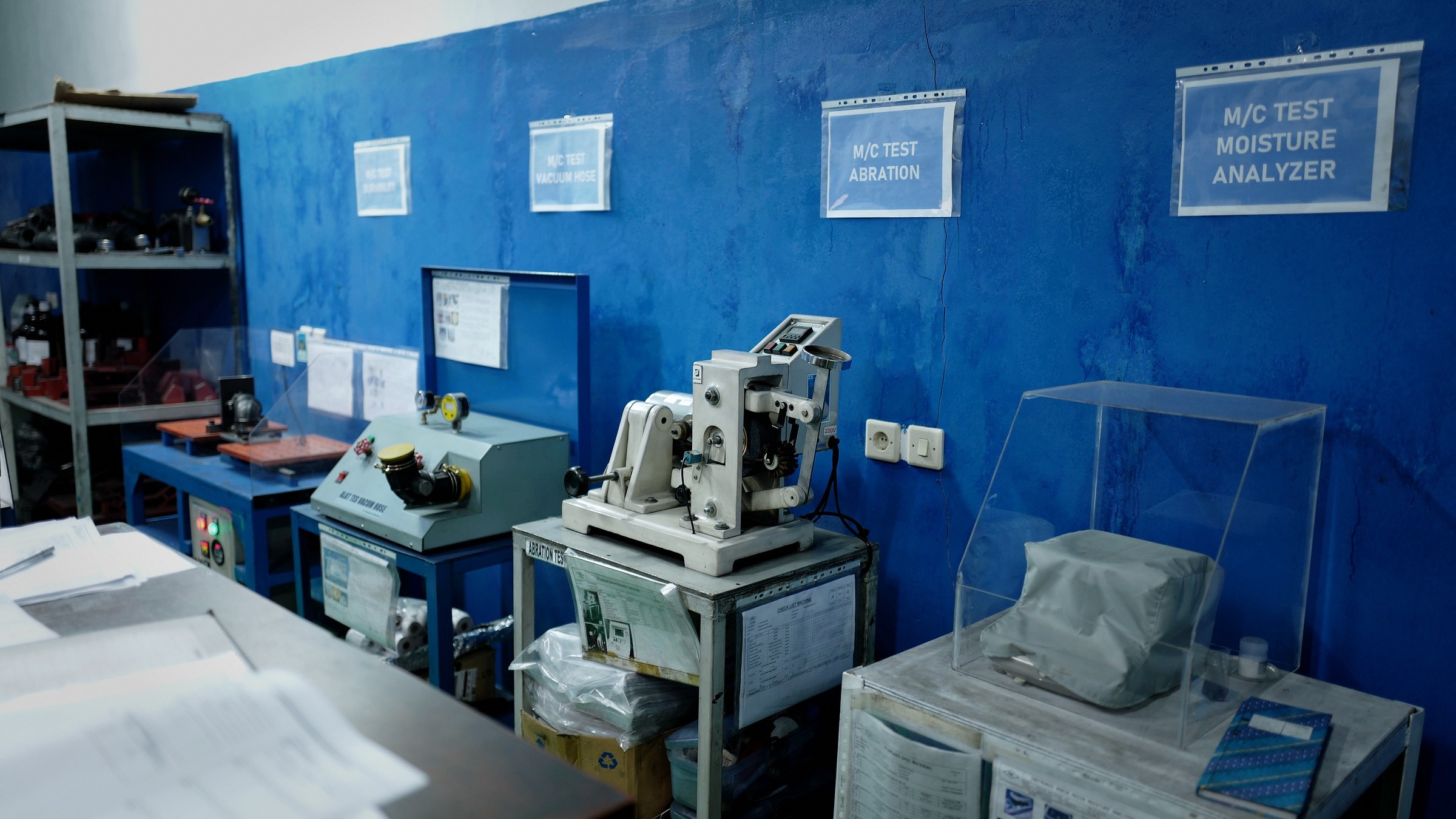
Our QC laboratory is equipped for end-to-end rubber-parts validation: Mooney viscometer, rheometer, UCAN tensile strength testers for elongation and tear, ozone tester (EPDM and ozone-sensitive parts), aging tester (thermal aging chambers for accelerated life prediction), endurance tester (fatigue-cycle testing for mounts, bushings, isolators), measuring microscope for small-feature dimensional QC, and tailor-made customer-specific test machines built to individual customer test specifications.
That last item — the customer-specific test rigs — is a signal that we operate inside deep, long-standing customer quality programs, not generic spec-sheet manufacturing.
Documentation and traceability
Every shipment is traceable back to the polymer batch and supplier, the compound mix lot, kneader/mill, and operator, the production date and the specific press, and the QC operator who released the lot. Certificates of Conformance and material test reports are supplied with shipments when stated on the purchase order. PPAP, APQP, FMEA, and SPC workflow available on request for automotive and industrial OEM programs.
More on the quality management system. Email marketingoem@pbrubberindo.co.id with your documentation requirements.