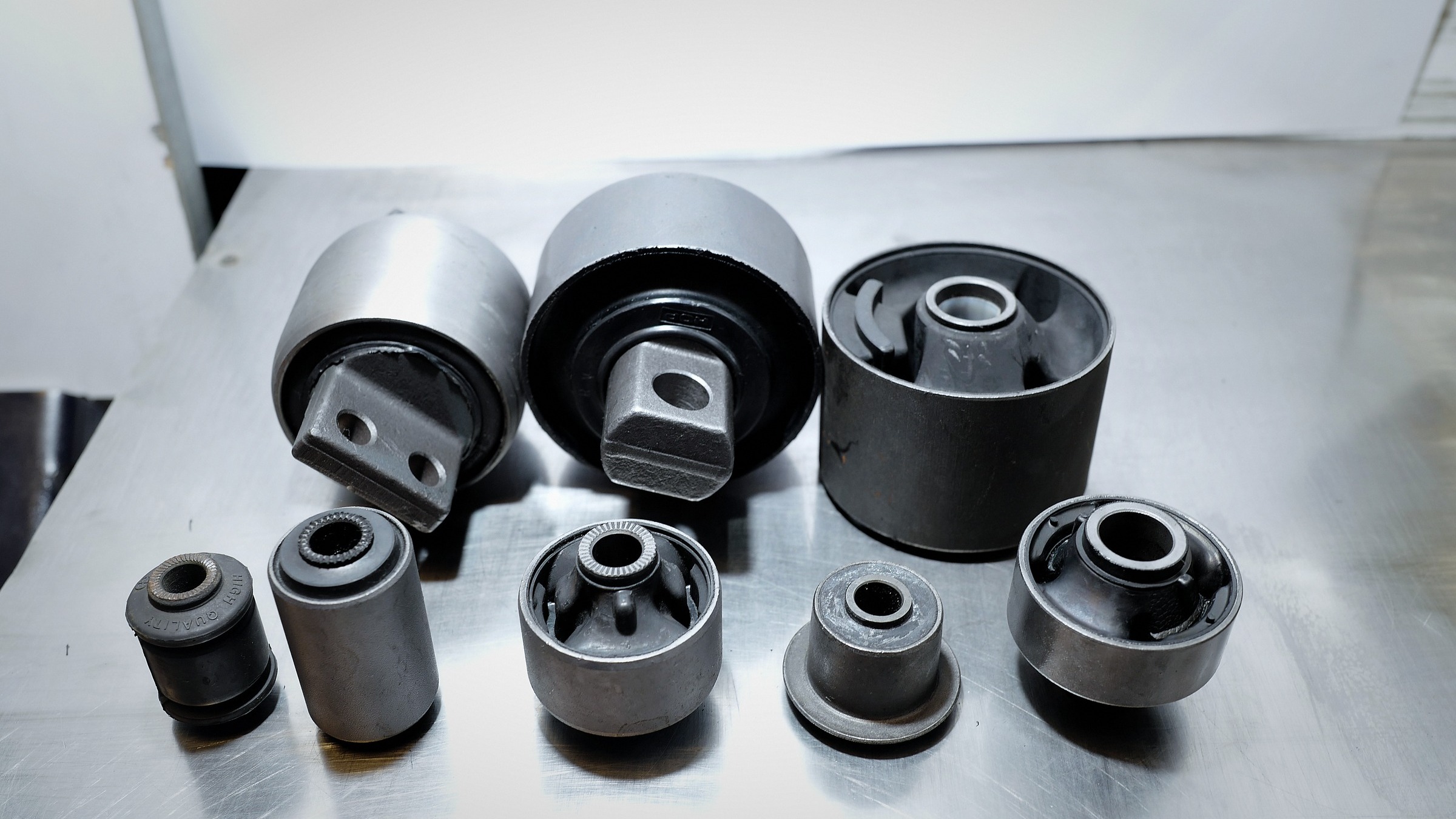
A rubber-to-metal bonded assembly is one where the rubber compound is chemically and mechanically locked to a metal insert during the molding cure. Done correctly, the rubber will tear before the bond gives up. This is the foundation of every modern engine mounting, every modern suspension bushing, and most industrial vibration isolators.
The process: surface prep is everything
The bond is only as good as the surface preparation. Skip a step and the part fails in the field, not on the bench.
- Degrease: solvent or alkaline clean removes cutting oils from the metal insert.
- Surface roughening: blast or chemical etch exposes fresh metal for the bonding agent to grip.
- Primer application: first-coat bonding agent.
- Top-coat bonding agent: formulated for the specific rubber compound that's about to be molded against it.
- Simultaneous mold and cure: rubber and metal cure together in one press cycle.
We use established bonding-agent systems in the Chemlok, Megum, and Cilbond families, matched to the rubber compound.
Typical OEM applications
- Engine mountings: rubber bonded between two metal brackets. The basis of the Hino, Suzuki, and Honda mounting programs that PBR has run since 2003.
- Suspension bushings: rubber bonded to outer sleeve, inner sleeve, or both.
- 2-wheel frame-rail bushings: rubber boss bonded into painted stamped-steel motorcycle frame.
- Vibration isolators: rubber bonded to mounting plates for industrial machinery.
- Custom bonded assemblies: built to drawing or sample.
Quality control: pull-tested every batch
Every bonded program is qualified with pull-tests before release to production, and per-batch pull-tests are run on production samples thereafter. Standard tests include peel adhesion for sheet geometries, pull-out / push-out for cylindrical bushings, and sample destruction to verify that failure occurs in the rubber, not at the bond line. Records are retained under our SGS-certified ISO 9001:2015 quality system; PPAP-style documentation is available for automotive customers in English, Indonesian, or Japanese (日本語対応) as required.
Material choices that matter
Bonding works across NR, NBR, EPDM, CR, FKM, and silicone. The choice of compound depends on the application: oil exposure, temperature, dynamic load case. For automotive mounts and bushings, NR and NBR cover most of the spectrum; FKM appears where heat and aggressive fluids are present.
Why in-house bonding matters
PB Rubber Indo runs bonding entirely in-house: compound mixing, surface prep, primer and top-coat application, molding, post-cure. There is no third-party bonding step, no shipped intermediate. That keeps lead time down, traceability tight, and IP secure. See our Metal & Rubber Parts range for the full catalogue.
Send your drawing or sample to marketingoem@pbrubberindo.co.id. We respond within one business day.