Three of the most commonly specified rubber compounds in OEM manufacturing are NBR (nitrile), EPDM, and silicone (VMQ). Each handles a specific corner of the application space well, and a different corner badly. Picking the wrong one is the difference between a part that lasts five years and one that fails in twelve weeks.
NBR (Nitrile)
NBR is the workhorse for oil contact. Trade names include Buna-N, Krynac, and Nipol; the polymer comes from Lanxess, Sumitomo, and others. NBR resists petroleum oils, fuels, hydraulic fluids, and greases up to roughly 100 °C continuous (130 °C for HNBR variants).
Use it for: oil seals, fuel hoses, automotive seals.
Watch out for: poor ozone and weather resistance. NBR cracks visibly when exposed to UV and outdoor ozone, so don't use it outside.
EPDM
EPDM is the opposite of NBR in important ways. Trade names include Keltan, Vistalon, and Royalene; suppliers include Lanxess and ExxonMobil. EPDM is the answer for water, coolant, weather, and outdoor exposure. Temperature range typically -40 °C to +120 °C.
Use it for: water seals, coolant hoses, weatherstrip, outdoor parts.
Watch out for: petroleum oils. EPDM swells in oil and rapidly loses properties.
Silicone (VMQ)
Silicone covers the temperature extremes. Trade names include Elastosil and the KE series. Service range -50 °C to +200 °C continuous, with peaks higher. Silicone is also dielectrically stable, which is why it's the default choice for high-voltage power infrastructure components, including the silicon insulator and dielectric parts PB Rubber Indo supplies into the power sector.
Use it for: wide-temperature applications, food contact, high-voltage power, medical-grade where applicable.
Watch out for: lower tensile strength and tear resistance than NBR or EPDM. Silicone parts can be molded to nearly any geometry but won't take the same mechanical abuse.
The five questions that pick the compound
- What fluid will the part touch? (Oil, fuel, water, coolant, hydraulic, air, food?)
- What temperature range? (Continuous and peak)
- How long does the part need to last? (Years, hours, cycles)
- Is there ozone, UV, or aggressive chemical exposure?
- What hardness and mechanical performance is needed? (Shore A 40–90, tensile, compression set, tear)
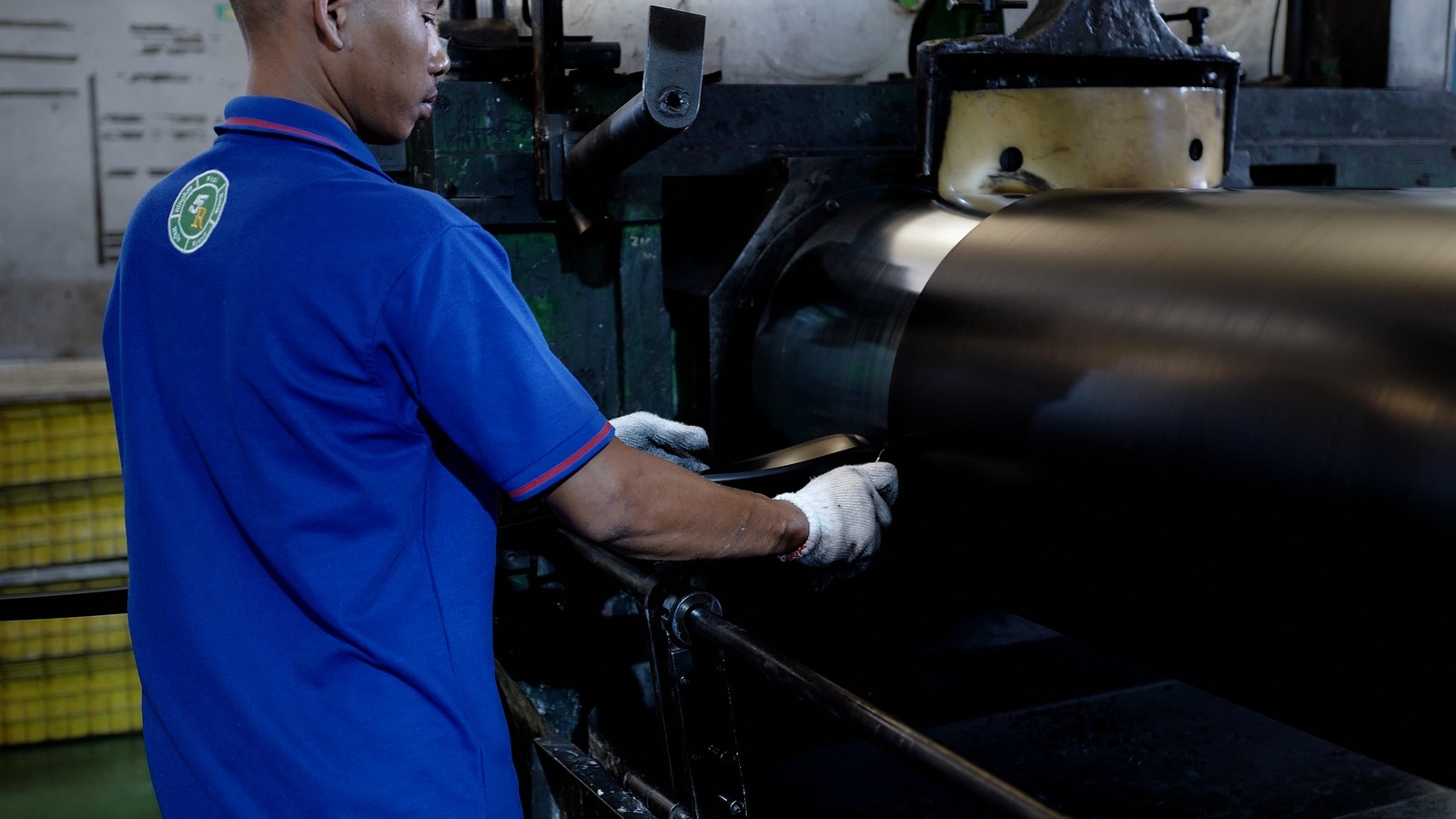
Send us those five answers plus your part drawing, and our team, matching compounds for Japanese OEM programs since 2003, will recommend the compound and grade. We compound in-house on 55-litre and 75-litre kneaders, with automatic chemical weighing and rheometer testing on every batch before it reaches a press. See our materials capability page for the full material family list.
Email marketingoem@pbrubberindo.co.id for compound selection support in EN/ID/JA (日本語対応).