ISO 9001:2015 is the international standard for quality management systems. A supplier that holds it has demonstrated, to an accredited third-party auditor, that they operate a documented process for designing, producing, inspecting, and delivering their product, and that the process is continuously improved.
What ISO 9001:2015 actually requires
The standard breaks down into ten clauses covering organisational context, leadership commitment, planning, support resources, operation, performance evaluation, and improvement. The audit verifies that a real, working system exists across all of those clauses, not just that a binder of procedures sits on a shelf.
For a rubber parts manufacturer, this typically translates to:
- Documented process for compound formulation and batch release
- Documented inspection at incoming, in-process, and final stages
- Calibration records on every measurement instrument
- Traceability from polymer batch through compound mix through molding through QC to shipment
- Corrective and preventive action (CAPA) logged and closed when issues arise
- Regular internal audits and management review
What ISO 9001:2015 does not require
It is important to be clear about what the standard does not cover. ISO 9001:2015 is a management system standard, not a product specification. It does not require any specific test (tensile, hardness, ozone, aging) be run on every batch. It requires that whatever tests the supplier commits to running are actually run, recorded, and reviewed. It also does not require PPAP, APQP, FMEA, or SPC workflow; those are automotive-industry add-ons that suppliers may layer on top.
Why the certifying body matters
The audit is only as credible as the auditor. Major globally recognised certifying bodies include SGS, TÜV, Bureau Veritas, DNV, and Lloyd's Register. A certificate from one of these means the audit was rigorous, documented, and subject to that body's own accreditation regime. PB Rubber Indo is certified by SGS and has held continuous certification since 2009, first to ISO 9001:2008, then upgraded to ISO 9001:2015.
What to ask your supplier beyond the certificate
- Certifying body? SGS, TÜV, BV, DNV, or LR are the global names. Local bodies vary in audit rigour.
- How long continuously certified? A supplier with 10+ years of continuous certification has demonstrated that the system survives leadership changes, customer cycles, and audit transitions.
- Scope of certification? Ensure the certificate covers manufacture of the parts you're buying, not just "trading" or "head office services".
- PPAP / APQP / FMEA / SPC available? If you're an automotive customer, you need this layered on top of ISO 9001:2015.
- Customer-specific test capability? A supplier with tailor-made customer test rigs has been running deep OEM programs for years.
How PB Rubber Indo applies this
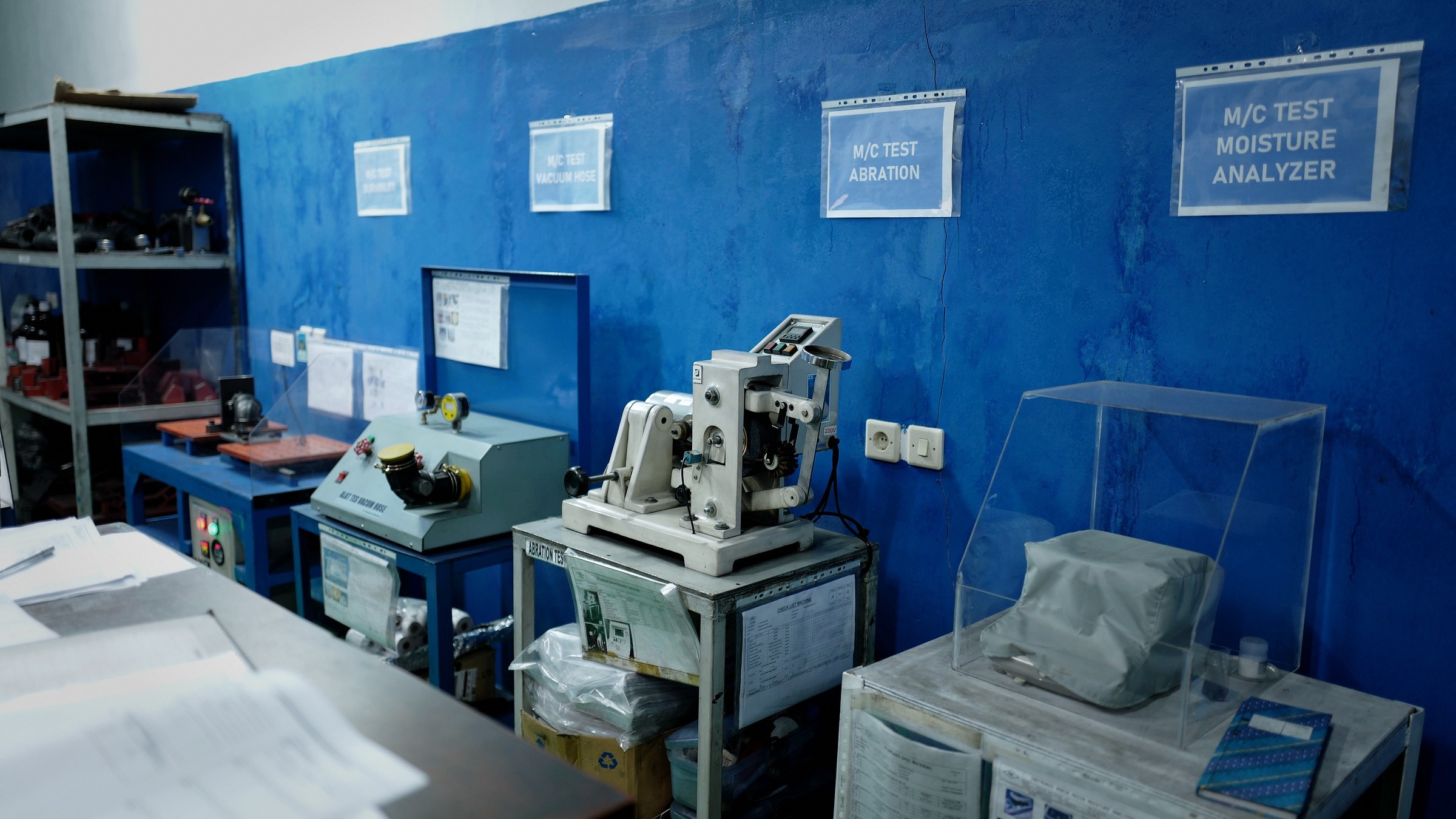
Our certification covers manufacture of rubber and rubber-to-metal bonded parts at the Cikupa factory. We run per-batch rheometer cure-curve checks on every compound before it touches a press, Mooney viscometer for processability, hardness on sample slabs, and a full QC lab with ozone, aging, endurance, tensile, and measuring microscope, plus tailor-made customer-specific test machines for PPAP-level programs. APQP, PPAP, FMEA, and SPC workflow is available on request for automotive and industrial OEM programs, with reports in English, Indonesian, or Japanese (日本語対応).
More on our quality management system. Email marketingoem@pbrubberindo.co.id with your documentation requirements.