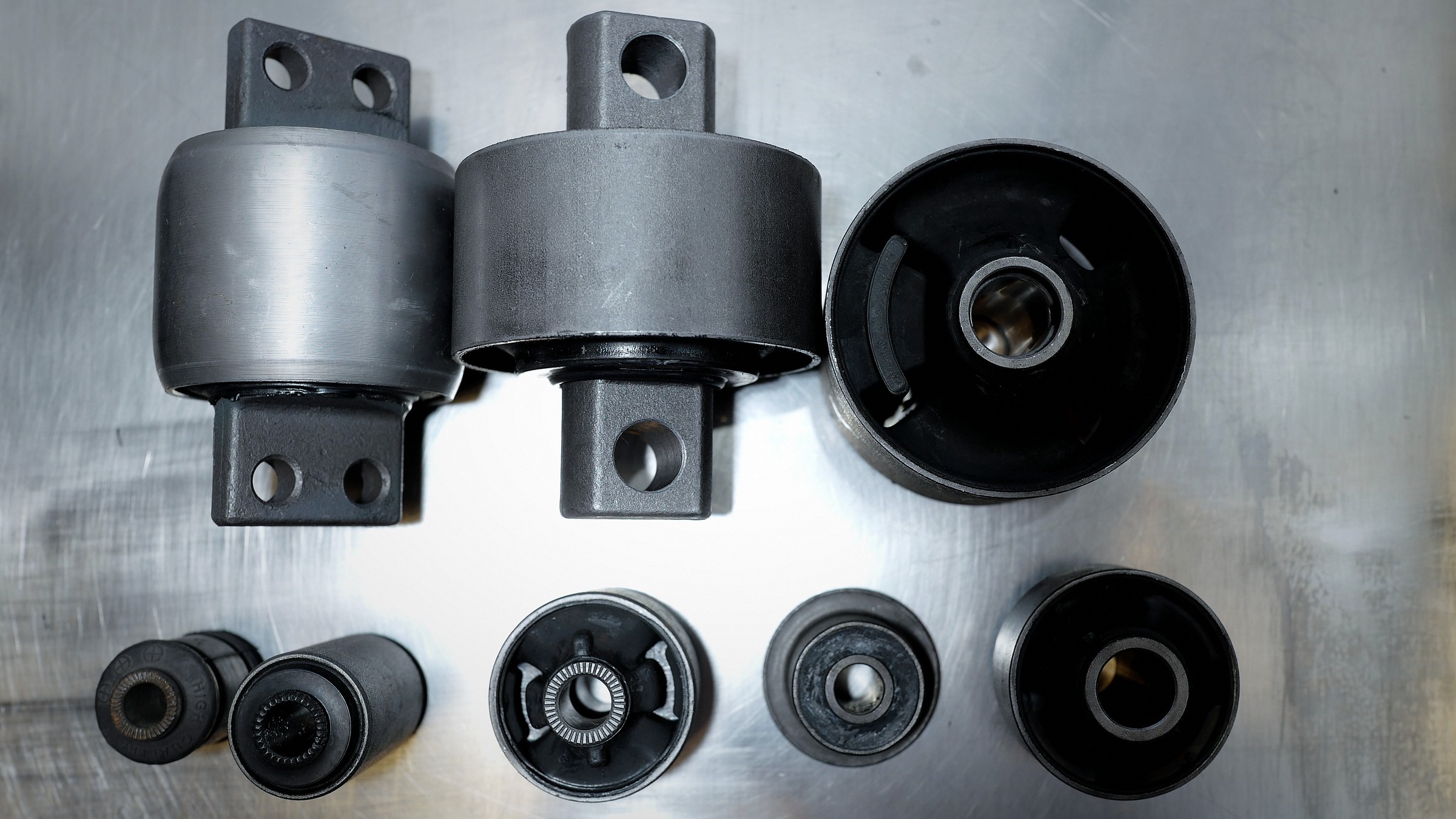
An engine mounting performs two jobs at once. It holds the engine securely to the chassis under braking, acceleration, cornering, and shock loads — and it isolates the chassis (and the passenger cabin) from the engine's own vibration. The rubber element absorbs and dissipates vibration; the bonded metal inserts provide the mechanical interface to the engine block on one side and the chassis frame on the other.
The three properties that matter
- Stiffness — how much the mount deflects under load. A mount that's too soft lets the engine move excessively under torque; one that's too stiff transmits vibration directly to the cabin.
- Damping — how much vibration energy gets converted to heat instead of being transmitted to the chassis. This is what the rubber compound's hysteresis does for you.
- Durability — how long those properties hold up through years of heat, oil exposure, cyclic loading, and ozone.
Tuning these three to a specific vehicle program is what mount-design engineering work is about. The compound, the geometry, and the bonded metal layout all play.
Material choices
| Compound | Typical use |
|---|---|
| NR (natural rubber) | High-resilience mounts where oil exposure is minimal |
| NBR (nitrile) | Mounts with potential oil contact |
| EPDM | Mounts where ozone and weather resistance matter |
| CR (neoprene) | Balanced oil and weather performance |
Hardness typically falls in the Shore A 45–70 range, depending on the load case.
NVH — noise, vibration, harshness
NVH is the umbrella term for the unwanted sounds and vibrations a driver feels through the steering wheel, the seat, and the pedals. Engine mounts are a primary NVH lever — alongside body bushings, exhaust hangers, and chassis isolators. Bad mount design or worn mounts shows up as a buzz at idle, harshness on uneven roads, or a vibration that builds at a specific RPM. Good mount design eliminates those signatures across the engine's entire operating range.
Why bonded matters
A modern engine mount is almost always a rubber-to-metal bonded assembly. The rubber is chemically and mechanically locked to the bracket during the molding cure. Done right, the rubber tears before the bond fails. At PBR we pull-test adhesion on every batch — the same discipline that earned the Hino Best Supplier 2009 recognition. See more on our bonding capability, or browse the full Metal & Rubber Parts range.
Custom mounts from drawing or sample
If you have an engine-mount program — passenger car, light commercial, truck, two-wheeler, or industrial engine — we can quote from a 2D or 3D drawing, from a physical sample, or from a concept description. Tooling is CNC-milled in-house, typical lead time 3 to 6 weeks. Email marketingoem@pbrubberindo.co.id with your specs.